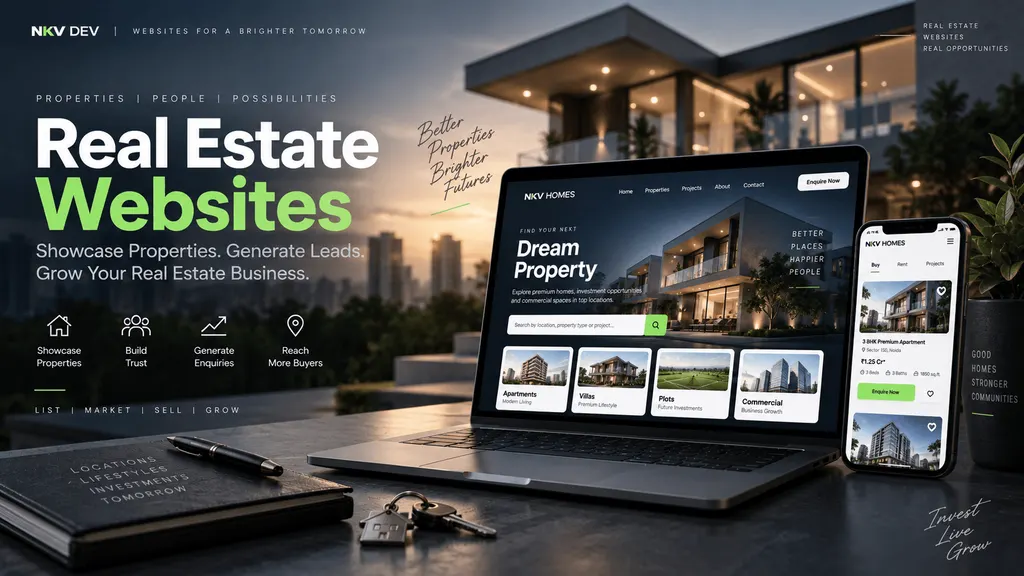
Property buyers rarely call an agent first. They open a phone, look at what is available in the area they already know, compare prices and floor plans, and only then decide who deserves a call. Everything a buyer needs for that first cut has to live somewhere online, and the sensible place for it is a professional real estate website you own and control.
Buyers want photographs, the location, the price, the amenities, the floor plan, available units, project details and a way to make contact. A site that holds all of it in one place does the work of a showroom and a sales desk at once.
What Is a Real Estate Website?
A real estate website is a site built to show properties, projects, services and company information online.
Agents, property consultants, builders, developers, property managers, commercial brokers and rental agencies all use one, though never in the same shape. A two-person agency needs a page for every listing on its books; a developer selling one tower needs a page for every configuration inside it.
A typical property page holds the project name, its location, the price, the property type, the built-up area, bedroom and bathroom counts, the amenities, a photo gallery, the floor plan, a map, an enquiry form and a call or WhatsApp button.
Why Is a Website Important for Real Estate?
1. Showcase Properties 24/7
Need a website built properly?
Fast, modern, fully owned — from ₹7,999, delivered in 1–2 weeks.
Chat on WhatsAppSee pricingA physical flat can be visited during working hours, and only after someone agrees to drive you there. A website shows the same flat at eleven at night to a buyer two cities away, and lets that buyer move from the photographs to the floor plan without booking anything.
That is roughly the difference between emailing a brochure and running a showroom.
2. Generate Property Enquiries
Traffic is a number that flatters a monthly report. What pays the bills is an enquiry with a name and a phone number attached, so a property site should make asking easy from every page. A site visit request, a short form, a call button and a WhatsApp link each ask for something small enough that a serious buyer will do it.
Interested in this property? Book a site visit with our property consultant.
The block above works because it names the property and the next step in two lines. Most enquiry boxes fail for the opposite reason: six fields and no sign that a person is on the other end.
3. Build Trust With Potential Buyers
A flat costs more than any other purchase most families ever make, so buyers check who they are dealing with before they hand over a phone number. Company history, completed projects, testimonials, certifications, the office address and RERA project information where it applies all answer the same unspoken question.
Telling a buyer that the company is established proves very little. Showing the projects it finished and the addresses it delivered at lets them reach that conclusion alone.
4. Create a Dedicated Page for Every Property
Individual property pages are the main reason a listing website beats a photo album. Take one example: a 3 BHK apartment in Noida, ₹1.25 crore, 1,850 sq. ft., three bedrooms, two bathrooms, two parking spaces, ready to move. That fits in a heading and a price line, and it already answers the questions that decide whether someone keeps reading.
The page can then carry an image gallery, a video tour, the floor plan, a location map, nearby landmarks, builder information and an enquiry form. One link on WhatsApp still looks professional a week later; a folder of images does not.
5. Help Customers Find the Right Property
A business with several hundred properties hits the same wall: one listing page stops working past a screenful. Search by location, project name or area, plus filters for property type, price range, bedrooms, status and location, let a buyer cut the catalogue down without calling anyone.
Apartments → 3 BHK → ₹80 lakh to ₹1.5 crore → Noida
Four filters and the buyer sees a shortlist instead of a catalogue, which saves your staff a call with someone who was never going to buy.
6. Real Estate Websites Can Target Local SEO
Property search is almost always local. Nobody looks for a flat anywhere in India. They look in the locality they commute from, near the school their children attend, or along the metro line they can afford.
Flats for sale in Noida
3 BHK apartments in Bangalore
Commercial property in Mumbai
Office space for rent in Pune
A site structured around locations and property categories can carry a page for properties in Noida, another for apartments in Noida, and another for commercial property there.
7. Showcase Entire Real Estate Projects
A developer sells something bigger than a listing: a location, a set of configurations, a completion date and a set of claims about the neighbourhood. Project pages carry the overview, the location and its advantages, the apartment configurations, the floor plans, the gallery, construction updates and a route to the sales team.
That turns a website into a digital project brochure a buyer reads at their own pace.
8. Digital Brochures Are Easier to Share
PDF brochures have two problems. They are heavy on a phone, and they go stale the moment a price changes, so a salesperson ends up sending a document that contradicts the website.
A project page solves both, because one link takes the buyer from the property to the project to an enquiry without leaving the site.
Real Estate Website vs Property Listing Website
The two terms get used interchangeably, though they describe very different amounts of work. A simple real estate website covers the company, a selection of properties and contact details, which is enough for most small agencies.
A property listing website grows into a platform: user accounts, property submissions, search, saved properties, agent profiles, maps, notifications, admin dashboards and lead management. The technology and the cost move with it, so decide which of the two you are commissioning before anyone quotes.
What Should a Real Estate Website Include?
A professional real estate website settles into a familiar skeleton. The homepage answers three questions before a visitor scrolls: who you are, what you sell and where you operate. Search and the main property categories belong directly under that, where a stock photograph of a skyline usually sits.
Every important property deserves its own page, because a dedicated page is the only thing a buyer can bookmark or forward to a spouse. Location pages let people browse by the area they have already chosen, an about page covers the company and its completed projects, and developers add a page per project.
The contact page needs phone, WhatsApp, email, office address, a map and an enquiry form, reachable from every screen without hunting.
WhatsApp Can Be a Powerful Real Estate CTA
Property enquiries usually begin with a small question rather than a decision. Is this unit still available. Can I visit on Saturday. What is the final price.
WhatsApp is where Indian buyers ask those questions anyway, so a chat button earns its place more than a form that insists on an email address. The path runs from the property page to WhatsApp, to an agent, to a site visit.
The website does not have to close the sale. It only has to hand a warm buyer to a person who can.
Real Estate Websites Can Include Maps
Location decides most property purchases, so a map is not decoration. A location block that shows the property on Google Maps alongside nearby schools, hospitals, metro stations, highways and business districts answers the question buyers ask immediately after the price.
For developers it doubles as the connectivity section: which highway runs closest, how far the airport is, what is being built nearby.
Property Photography Matters
Real estate is a visual trade, and poor photographs make a good property look like a bad one. That means a photographer who shoots property rather than weddings, images compressed for mobile data, and galleries that hold up on a phone.
Floor plans need to be legible without zooming.
Mobile Experience Is Extremely Important
Most property browsing happens on a phone, often on a commute, frequently on a connection that is not fast. Build the small screen first: filters a thumb can operate, touch targets large enough to hit, enquiry forms short enough to finish, and click-to-call wired into the header.
A buyer who cannot reach an agent from the bus will reach a different agent instead.
Real Estate Websites for Different Businesses
The requirements follow the business model.
Real Estate Agents
An agent needs properties, a profile that establishes credibility, location pages and a reliable enquiry route. The property list also has to be easy to update, because a stale listing damages trust faster than a missing one.
Property Developers
A developer needs projects, floor plans, galleries, location details and enquiries, usually organised per project rather than per unit. Construction updates are the section that keeps returning visitors coming back.
Builders
Builders can showcase projects, completed work, current developments and services. Completed work carries more weight than any sentence about experience, which is why photographs of finished buildings belong on the homepage.
Commercial Property Consultants
A commercial site covers office spaces, warehouses, industrial properties and land, with filters for location, area and price. Buyers here compare fewer options and read far more of each page, so detail matters more than volume.
Rental Agencies
Rental businesses need searchable listings for apartments, houses, offices and shops. Availability is the number that changes daily, and the enquiry is the only conversion that counts, so both should be visible without a click.
A Real Estate Website Can Become a Lead-Generation System
A property site sits in the middle of everything else a business runs. Someone searches on Google, lands on a property landing page, opens the details, sends an enquiry, then moves to a call and finally a site visit. A second path starts on Instagram, goes to the project website, into the gallery and the floor plans, and ends at a visit booking.
Both end in the same place. The website becomes the one destination your marketing can point at, instead of attention scattering across platforms you rent rather than own.
What About a Real Estate Admin Dashboard?
Past a few dozen listings, editing pages by hand becomes a bottleneck. A custom real estate platform can give staff a dashboard where they add properties, edit prices, upload images, manage enquiries and publish new listings.
The listing then travels from the dashboard to the database to the website to the customer with no developer in the middle, so the site stays current between redesigns.
Technology Behind a Modern Real Estate Website
Stack choice should follow the size of the job rather than the fashion of the year. A small site runs well on Astro with TypeScript, deployed to Cloudflare. A property catalogue adds a CMS so staff can publish without touching code. A more interactive platform needs React, a typed API and a database, and a large custom platform adds a backend, authentication and cloud infrastructure.
Pick the smallest stack that covers today’s requirement, with one step up available when the listings outgrow it.
SEO Is an Important Part of Real Estate Websites
Property searches carry a lot of intent in very few words: a location, a property type, a budget, a bedroom count, commercial or rental.
2 BHK flats for sale in Bangalore
Commercial office space in Noida
Residential plots in Bangalore
Luxury apartments in Mumbai
Pages built around searches like those bring relevant organic traffic, because they answer a question someone actually typed. Pages stuffed with keywords bring nothing worth counting, since a buyer who lands on thin content leaves. Useful property information is the only durable ranking asset.
The Goal Isn’t Just More Traffic
A property site can pull thousands of visitors and still produce a weak month, so the numbers worth watching sit further down the funnel: property page views, search activity, enquiries, WhatsApp clicks, phone calls and site visit requests.
Those tell you which properties attract interest and which pages waste it. A visitor count tells you neither.
Bringing Property Information, Search and Enquiries Together
A professional real estate website ends up doing far more than holding photographs. It works as a showroom, a catalogue, a lead-generation system, a project brochure and a local search asset, and it pulls property information, search visibility and customer enquiries into one place.
The design should follow how your buyers search and compare rather than how the industry presents itself. A visitor should be able to move from “I am looking for a property” to “I found a property I am interested in” to “I want to contact the agent and schedule a visit” without leaving the site.
At NKV Dev, we build websites around that process, combining design, performance, SEO, property catalogues, enquiry systems and modern web technology. Want a property website that generates enquiries? Get in touch or explore our website development services.
Tags
#real-estate-website#real-estate-website-design#real-estate-website-development#property-listing-website#real-estate-website-for-builders#real-estate-website-for-agents#real-estate-website-for-developers#property-catalogue-website#real-estate-lead-generation#property-website-development#real-estate-business-website#real-estate-property-website#property-listing-website-development#real-estate-portal-development#property-search-website#real-estate-landing-page#builder-website-design#property-developer-website