Why Astro.js Is My Go-To Framework for Modern Websites
Discover why Astro.js has become one of my favorite frameworks for building fast, SEO-friendly, and content-focused websites. Learn how it improves performance, developer experience, and scalability.
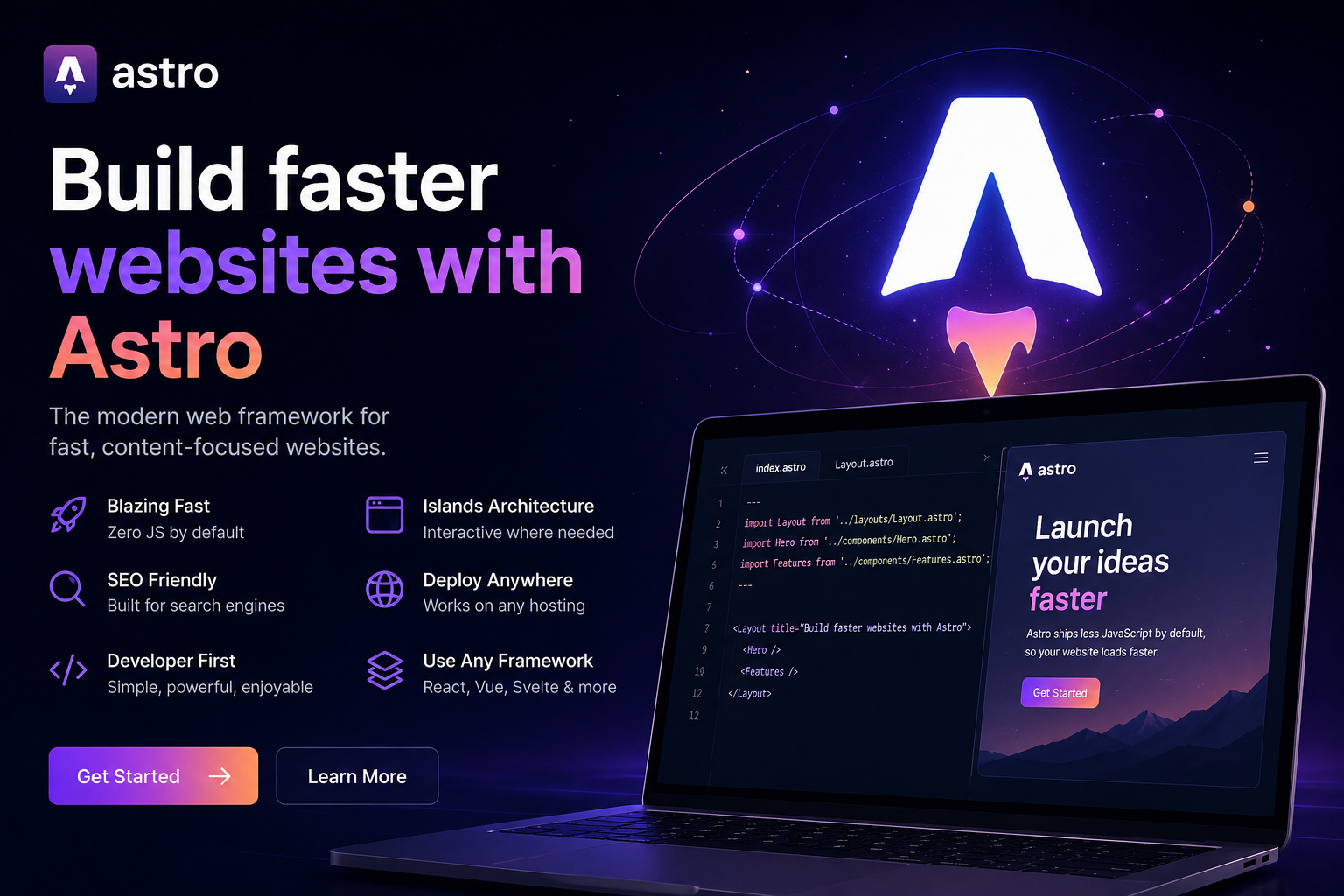
Why Astro.js Is My Go-To Framework for Modern Websites
If you’ve spent any time building websites, you’ve probably come across frameworks like React, Next.js, Vue, or Svelte. They’re all great tools, but over the past year, one framework has completely changed the way I build websites—Astro.js.
Whether I’m creating a personal portfolio, a business website, or a blog, Astro has become my first choice. It’s fast, simple to work with, and helps me deliver a better experience to my clients.
In this article, I’ll explain why I enjoy using Astro.js and why I think it’s worth learning.
What Is Astro.js?
Astro.js is a modern web framework designed to build fast, content-focused websites.
Unlike many JavaScript frameworks that send large amounts of JavaScript to the browser, Astro ships HTML by default.
That means your visitors download less code, resulting in:
- Faster page loads
- Better SEO
- Improved Core Web Vitals
- Smoother browsing experience
In simple words, Astro sends only what the user actually needs.
Zero JavaScript by Default
One of Astro’s biggest advantages is its Zero JavaScript by Default philosophy.
Imagine you have:
- A navigation bar
- A blog article
- Images
- A footer
None of these need JavaScript to work.
Traditional frameworks may still send JavaScript for these components.
Astro doesn’t.
It generates clean HTML during build time and only loads JavaScript when a component truly needs it.
For example:
- Search bars
- Dark mode toggle
- Contact forms
- Interactive maps
- Image sliders
This approach makes websites noticeably faster.
Islands Architecture
Astro introduced a concept called Islands Architecture.
Instead of making your entire website interactive, Astro lets you choose exactly which components should use JavaScript.
Think of your website as an island.
Most of the island is static and lightweight.
Only a few small areas need interaction.
Those interactive sections become islands, while everything else stays fast and static.
This gives you the best of both worlds:
- Great performance
- Rich user interactions
Build With Your Favorite Framework
One thing I really appreciate about Astro is that it doesn’t force you into a single ecosystem.
You can use:
- React
- Vue
- Svelte
- Solid
- Preact
- Vanilla JavaScript
…all inside the same project.
If your project already uses React components, you can easily include them without rebuilding everything from scratch.
Perfect for Blogs
Astro was practically made for blogging.
It comes with excellent support for:
- Markdown
- MDX
- Content Collections
- Syntax highlighting
- RSS feeds
- Sitemap generation
- SEO metadata
Instead of storing blog posts in a database, you can simply write Markdown files inside your project.
This keeps everything organized, version-controlled, and easy to maintain.
Excellent SEO
Search engines love fast websites.
Since Astro generates static HTML during build time, search engines can crawl your pages without relying heavily on JavaScript.
Combined with:
- Clean URLs
- Meta tags
- Open Graph support
- Structured content
- Automatic sitemap generation
Astro makes SEO much easier.
Fast Development Experience
Astro offers a clean and beginner-friendly development experience.
Some features I enjoy include:
- File-based routing
- Simple component syntax
- Easy API routes
- Built-in image optimization
- TypeScript support
- Vite-powered development server
- Excellent documentation
Even beginners can become productive fairly quickly.
Great Performance
Performance has become increasingly important.
Google rewards fast websites, and visitors expect pages to load almost instantly.
Astro helps by:
- Sending minimal JavaScript
- Optimizing images
- Generating static HTML
- Reducing unnecessary network requests
- Supporting partial hydration
The result is a website that feels incredibly responsive.
Why I Chose Astro for NKV DEV WORKS
When I started building NKV DEV WORKS, I wanted more than just a good-looking website.
I wanted a platform that would be:
- Fast
- Easy to maintain
- SEO-friendly
- Scalable
- Simple to update with new blog posts
Astro checked every box.
It allows me to focus on creating content and building useful features instead of worrying about unnecessary complexity.
Whether I’m writing technical articles, showcasing projects, or helping clients through my portfolio, Astro provides a solid foundation.
Is Astro Good for Beginners?
Absolutely.
If you already know:
- HTML
- CSS
- Basic JavaScript
You can start learning Astro without much difficulty.
The framework feels familiar because it builds on web standards instead of replacing them.
As you grow, you can gradually explore:
- Content Collections
- API Routes
- Integrations
- Server Rendering
- Authentication
- CMS integrations
There’s plenty of room to expand your skills.
When Should You Use Astro?
Astro is an excellent choice for:
- Personal portfolios
- Business websites
- Blogs
- Documentation websites
- Landing pages
- Company websites
- Marketing websites
- Developer portfolios
If your website is mostly content with a few interactive features, Astro is hard to beat.
Final Thoughts
There isn’t a single framework that’s perfect for every project, but Astro comes surprisingly close for content-driven websites.
Its focus on performance, developer experience, and simplicity makes it one of the most enjoyable frameworks I’ve worked with.
If you’re planning to build a blog, portfolio, or business website, I highly recommend giving Astro.js a try.
At NKV DEV WORKS, it’s become an important part of my workflow, and I don’t see that changing anytime soon.
The web is moving toward faster, more efficient experiences, and Astro is leading that movement.