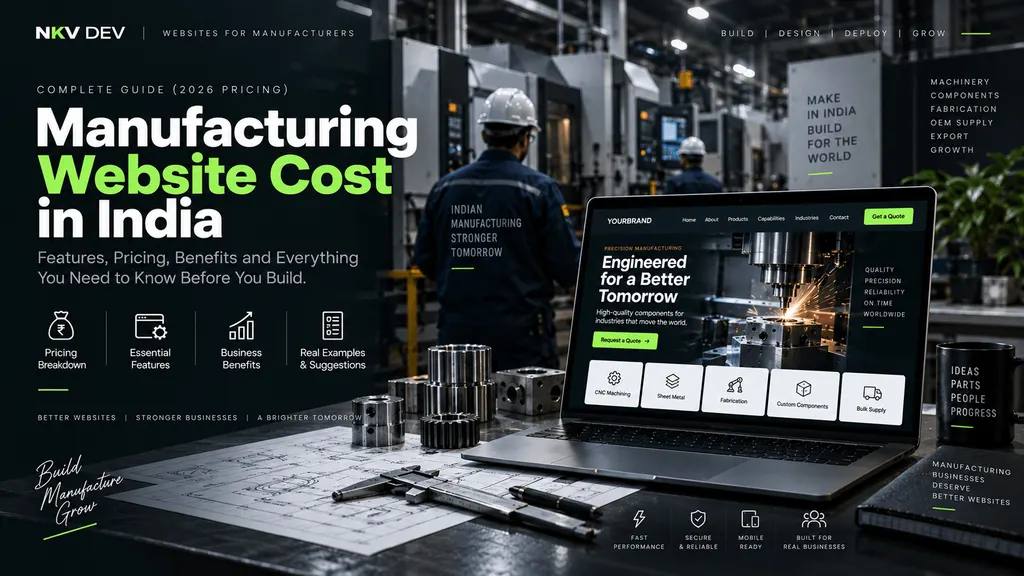
Manufacturing website cost in India in 2026 sits between ₹25,000 and ₹4,00,000 for a one-time build, with a well-scoped product catalogue site for an Indian MSME typically landing at ₹75,000 to ₹1,80,000 from a mid-market agency. The published bands are consistent across agencies: Delhi agency Nurotech puts small-business sites at ₹20,000 to ₹60,000 and B2B service sites at ₹40,000 to ₹1,50,000 (Nurotech, 2026), SAM Web Studio publishes ₹25,000 to ₹5,00,000 across three tiers (SAM Web Studio, 2026), and ColorWhistle quotes ₹1,80,000 to ₹3,80,000 for a medium-complexity manufacturing site (ColorWhistle, 2026).
Those numbers are real, and they are almost useless on their own. The same scope attracts quotes that differ by a factor of five, and the one-time price is only part of what you spend.
Why website pricing in India is so confusing
The confusion is structural rather than accidental. Indian agencies price on a tier ladder, and the tiers describe effort rather than output. A Basic tier and a Growth tier may produce visually similar websites, but one was built from a purchased template with the client’s logo dropped in, while the other was designed from a blank page with content written for it.
The tier names hide that difference. Basic, Starter, Standard, Professional, Advanced carry no shared definition between two agencies, so a Professional tier at one firm can mean less than a Starter tier at another.
Nurotech documented a case that makes the problem concrete: a Delhi manufacturer showed them a ₹2,80,000 quote in which roughly 60% of the “custom design” work was an unchanged commercial theme that retails for about ₹3,000 on a template marketplace. The same scope, rebuilt against a written specification, came in at ₹1,40,000. Nobody was cheating on the hourly rate. The client was being sold a template at a bespoke price.
Scope drift is the other big inflator. A fixed-price proposal leaves out content and photography, then bills them as change requests once the project is moving. Geography adds a premium too: Mumbai and Bengaluru agencies price roughly 15% to 25% above Delhi NCR for identical scope, mostly because rent and salaries cost more there.
For a manufacturer, the practical consequence is that a quote tells you what someone wants to be paid, not what you will receive. Price the specification, not the tier label.
The real price bands for a manufacturing website in India
These are the published 2026 manufacturing website cost bands and what each one actually buys. Treat the rupee figures as ranges rather than rules.
- ₹5,000 to ₹25,000 buys a template or a builder plan: a purchased theme or a website-builder subscription, your content poured in, a contact form, a basic product grid. That is a legitimate choice for a trading business which needs a credible address on the internet and nothing more. SAM Web Studio is blunt about this band: below roughly ₹25,000 a builder is the sensible recommendation, because no agency can deliver considered work at that level (SAM Web Studio, 2026). Nurotech goes further and calls a custom-designed site below ₹25,000 a red flag (Nurotech, 2026).
- ₹25,000 to ₹75,000 buys a small branded site: custom design on a standard stack, five to ten pages, a product listing, decent on-page SEO, mobile-friendly throughout. Fine for a job-work unit or a young MSME with a short catalogue. Dextrous Info lists ₹25,000 to ₹60,000 for its basic tier (Dextrous Info, 2026).
- ₹75,000 to ₹1,80,000 buys a proper product catalogue site, the band where a manufacturer’s website starts doing commercial work. Expect a structured catalogue with categories and product-level specification tables, downloadable datasheets or a PDF catalogue, an RFQ or enquiry flow, a dealer locator, and SEO built around product and application terms rather than the company name. Dextrous puts its mid tier at ₹60,000 to ₹1,50,000, and ColorWhistle’s manufacturing estimate starts at ₹1,80,000.
- ₹1,80,000 to ₹4,00,000 and above buys a lead-generating or global site: multi-language builds, an ERP or CRM integration, dealer portals, configurators, e-commerce for spares and consumables, export-market landing pages, and a content programme attached. ColorWhistle’s manufacturing range of ₹1,80,000 to ₹3,80,000 sits here, as does the top tier of most published ladders.
Freelancers bracket the whole thing at the bottom, with Mediaverse reporting ₹15,000 to ₹40,000 for freelance work against ₹40,000 to ₹80,000 for an agency starter package (Mediaverse, 2026). The gap between those two numbers comes down to accountability and documentation. It also comes down to who is still answering the phone in month eleven.
What actually moves the price
Need a website built properly?
Fast, modern, fully owned — from ₹7,999, delivered in 1–2 weeks.
Chat on WhatsAppSee pricingNurotech’s breakdown of a typical build is the most useful published split: design 25% to 40% of the total, development 30% to 50%, content and copywriting 10% to 20%, and SEO setup 5% to 15%. Recurring hosting and maintenance sit outside that split entirely. Two quotes that both say design and development can still divide those bands very differently, and a handful of variables decide where any given manufacturing website cost lands.
Catalogue depth and structure is the biggest single swing factor, and both sides usually underestimate it. Ten products can live on one page. Four hundred products across nine categories, each with a specification table, an application note and a datasheet, is a content and database project rather than a page build. Typing is the smallest part of that bill.
Most of it goes on collecting tolerances and grades from your engineering team, agreeing which figures are safe to publish, building a structure that survives the next forty products, and keeping the pages current when a grade changes. A quote that treats four hundred products as four hundred pages runs out of budget in month two.
Whether the design is actually custom matters nearly as much. A theme adaptation costs a fraction of a blank-page design system, and the two look similar in a portfolio grid. Ask which one you are buying, in writing, rather than judging from screenshots.
Integrations each add days of work and their own ongoing failure modes: a Tally or ERP sync, a CRM handoff, a payment gateway, WhatsApp Business API routing, multi-currency pricing. Each one should appear in the proposal as its own line item, because “integrations included” is where quotes quietly diverge from delivery. It is also where a cheap quote turns into an expensive project, since an integration that is attempted and abandoned still gets billed.
Content production is the line most often assumed rather than priced. If you cannot supply finished product descriptions, images and specification tables, someone has to write them, and for a 60-product catalogue that commonly runs ₹15,000 to ₹50,000. Check whether your quote includes it or assumes you will. Photographs sit inside the same bill: sixty SKUs shot to a consistent angle and background is studio work, and mismatched images are the fastest way to make an expensive catalogue look amateur.
Every additional language carries a translation, a URL structure and a permanent maintenance burden, and machine translation reads badly to an export buyer who is checking whether you are a credible supplier. Export-facing sites also need region-specific landing pages, documentation, and often a different enquiry flow from the domestic site. None of these variables appear in a tier table, which is why a tier table cannot price your project.
SEO setup at build time is a small line item: proper titles, structured data, a sitemap, internal linking. Ongoing content and link work is a monthly engagement and sits outside the build. Plenty of manufacturers read “SEO included” on a proposal and only later discover that it meant meta tags.
Why a ₹7,999 website and a ₹2,80,000 quote can both be honest
The same brief attracts a ₹7,999 quote and a ₹2,80,000 quote because they are not the same product. A ₹2,80,000 agency quote carries a sales team, a project manager, a designer, a developer, QA, an account manager, an office and a licence stack. Every one of those is a real cost, and the client pays for all of them whether or not the work needs them.
A lean studio on a modern static stack has a different cost base. There is no monthly page-builder licence, no plugin subscription stack, no server to patch, and no layer of account management between you and the person doing the work. The overhead is smaller, and the price reflects the overhead.
What a low price cannot buy is volume of custom scope. At the very bottom you are buying a template plus your own labour in filling it. That is a fair trade for a small unit and a bad one for a manufacturer whose buyers shortlist suppliers on downloadable specifications.
So the test that matters is not the number but whether the quote names what you are getting. A ₹28,000 quote listing every page, every template and every integration is more trustworthy than a ₹2,00,000 quote that says “complete custom website” and nothing else. Ask any agency, at any price, to write down the page list, the catalogue structure, the integrations, the content responsibility and what happens after launch. Whoever answers precisely is the one to hire.
If your requirement is really a small branded site with a working enquiry form, a transparent lean quote is the right spend and there is no reason to pay agency-tier overhead for it. If it is a 300-product export catalogue with ERP integration, no ₹20,000 quote will produce it, and the agency bands reflect the work involved. Match the scope, not the brand of the vendor.
The recurring costs nobody quotes you
The one-time build is the smaller half of the lifetime cost. These are the lines that go missing from proposals.
- Domain: ₹600 to ₹1,500 per year for a
.inor.com, depending on registrar. Trivial, but it is yours to keep paying. - Hosting: static sites can run on free or near-free edge hosting, which is why lean studios can quote low and still deliver fast pages. Conventional CMS builds typically cost ₹2,500 to ₹8,000 per year on shared hosting, or ₹9,000 to ₹30,000 per year on a managed plan sized for an image-heavy catalogue.
- SSL: free via Let’s Encrypt on any competent host. Anyone charging ₹3,000 to ₹8,000 per year for a certificate is reselling something that costs nothing, unless it is an extended-validation certificate, which a manufacturer almost never needs.
- Licences and plugins: a page-builder licence with the necessary add-ons commonly runs ₹12,000 to ₹35,000 per year, and it scales with features. This is the recurring cost that most often turns a cheap build into an expensive three-year total, and no one-time quote shows it.
- Maintenance and support: ₹3,000 to ₹15,000 per month, or roughly ₹20,000 to ₹75,000 per year for a small business under a retainer. Decide explicitly whether you are buying this or handling it internally.
- The per-change clause: watch for “₹500 per change” terms. They are reasonable for small edits and punitive for structural ones, and they convert routine content updates into a running bill. Ask for a defined monthly allowance of edits instead.
- GST: website development is a service, and 18% GST applies on top of the invoice. A registered business can generally claim input credit, so the cost is often neutral for a GST-registered manufacturer, though the cash leaves long before the credit arrives. A ₹1,00,000 quote is a ₹1,18,000 payment.
- Payment gateway and communication APIs: gateways charge roughly 2% per transaction, and WhatsApp Business API messaging is metered. Neither is large, and both recur.
Total cost over three years, not one
A one-time manufacturing website cost is the wrong unit of comparison. Indian manufacturers increasingly pay for marketplace visibility instead, and those costs recur by design.
IndiaMART’s premium supplier packages run roughly ₹50,000 to ₹1,20,000 per year, on top of the time spent answering enquiries at an enquiry-to-payment conversion rate that a 2026 benchmark analysis put at around 2.3%. IndiaMART’s own Q4 FY26 results showed about 27 million unique business enquiries against roughly 8.7 million supplier storefronts, which is a large pool and a heavily contested one.
Set that against a website:
| Three-year cost | What you own at the end | |
|---|---|---|
| Marketplace subscription | ₹1,50,000 to ₹3,60,000 | A listing you rent, that stops the month you stop paying |
| Template site | ₹5,000 to ₹25,000, plus platform subscription | A rented template you can leave |
| Custom catalogue site | ₹75,000 to ₹1,80,000, plus ₹20,000 to ₹75,000 per year upkeep | An asset that compounds |
| Agency site with integrations | ₹1,80,000 to ₹4,00,000, plus upkeep | A system, with a vendor dependency |
The marketplace line is worth what you pay for it. What it cannot do is carry a strategy on its own, because a marketplace puts you in a queue beside every competitor with identical specifications. That is precisely why the same benchmark found supplier listings with 50 or more products and detailed specifications converting at 3.8%, against 1.4% for listings with fewer than ten.
Completeness separates the listings that work from the ones that collect dust, and the same logic applies to your own catalogue, where you are the only supplier and no competitor is listed beside you.
A website with a real catalogue also changes what a marketplace subscription does for you. It becomes a destination for buyers who want to check you are real, rather than the only place you exist.
How to compare two manufacturing website quotes
Put the two proposals side by side against these ten lines.
- Page count and page list: named pages, not a number.
- Catalogue structure: categories, products per category, spec tables, datasheets, filters, search.
- Design origin: custom from a blank page, or an adapted theme. Get it in writing.
- Integrations: Tally, ERP, CRM, payment, WhatsApp, multi-currency, each named.
- Content: who writes product descriptions and supplies images?
- Languages and export pages: counted individually.
- SEO scope: on-page setup only, or a content programme?
- Handover: code and domain ownership, plus a migration path.
- Recurring costs: hosting, licences, maintenance, per-change rate.
- GST: included, or added at 18%.
A quote that answers all ten is comparable to any other that answers all ten. One that answers three is a number, not an offer.
Questions manufacturers ask about website cost in India
Is a ₹7,999 website good enough for a manufacturer? It is good enough for a small unit with a short catalogue that needs a credible presence and a working enquiry form. It is not enough for a manufacturer whose buyers shortlist suppliers using downloadable specifications, because producing that content is the work.
Why do agencies charge ₹2,80,000 when a template costs ₹3,000? Because you are not buying the template. You are buying design, content structuring, catalogue build, integrations, testing, and a team that supports it afterwards. The failure case is not the price, it is when an agency charges bespoke prices for template work, as the ₹2,80,000 case above shows.
What drives manufacturing website cost the most? Catalogue depth and structure, by a wide margin. A designer working across ten pages costs a known amount. Four hundred products with specification tables, datasheets and application notes is a content and database project, and the copywriting alone commonly runs ₹15,000 to ₹50,000. If you want to control manufacturing website cost, start by deciding how much of your catalogue actually needs to be online, and in how much detail.
Does a more expensive website rank better on Google? Not directly. Ranking follows content, structure, page speed and links. A fast, well-structured site in the ₹75,000 band will outrank a slow ₹3,00,000 site every time. What a higher budget buys is the content and structure that ranking actually needs.
Do I pay GST on website development? Yes. 18% GST applies, and a GST-registered business can typically claim input credit.
Should I pay in instalments? Milestone payments are normal and reasonable: a booking advance, a design sign-off payment, a build payment, and a launch payment. Never pay the full amount up front to a vendor you have not worked with.
Who owns the code when the project ends? You should, and it should say so in the contract. Ask for the repository and the domain to be transferred to accounts you control.
What is the cheapest way to get a manufacturing website that actually works? Write the specification yourself before you talk to anyone. List your pages, your catalogue structure, your integrations, your content. A precise brief removes most of the ambiguity that agencies price as risk, and it lets a lean studio quote accurately against a real scope instead of padding for the unknown.
Next step
If you want a manufacturing website priced against your actual catalogue rather than a tier label, look at our transparent pricing and then send us your product list and page requirements. Include the integrations you actually need and who will supply the content, and you get a scoped number rather than a range. If a smaller spend covers the requirement, we will say so.
For the design and content decisions that determine whether the site brings enquiries at all, read industrial website design for manufacturers in India and the general guide to what a website costs in India. If your requirement is a structured product catalogue with specification tables and datasheets, start with our industrial website design service and our notes on digital catalog websites.
Tags
#manufacturing website#website cost India#industrial SEO#B2B website#MSME